OPNsense WireGuard Site to Site Tunnel: Routing Setup
Connect two OPNsense networks with WireGuard, preserve IoT isolation, configure Allowed IPs and firewall rules, and troubleshoot CGNAT
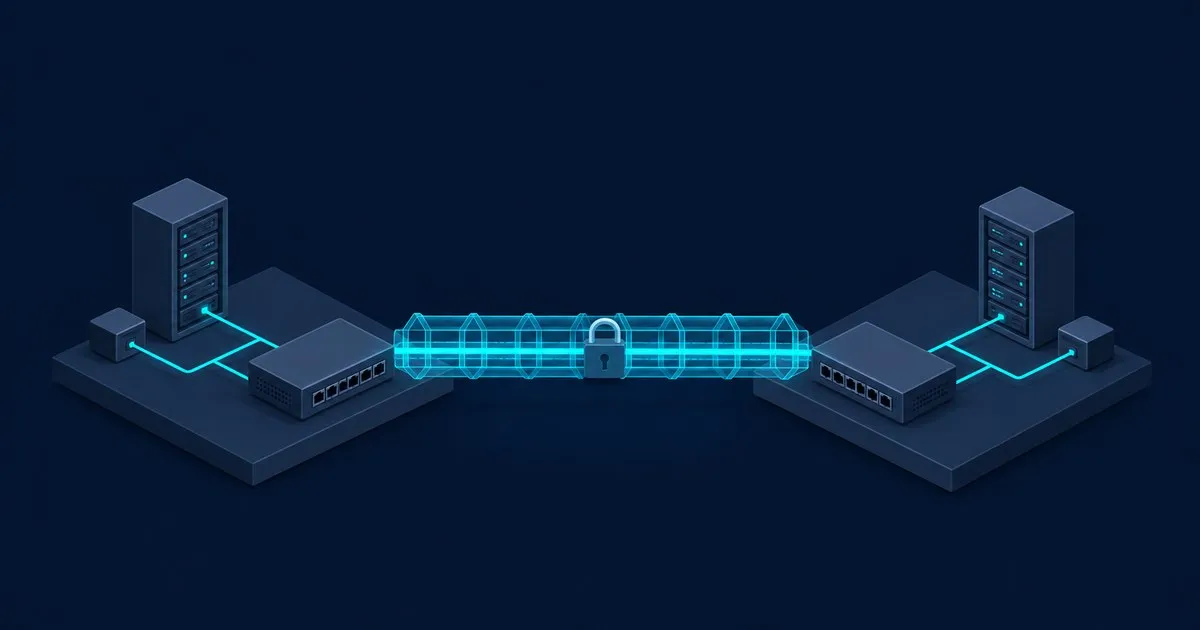
An opnsense wireguard site to site tunnel connects routed networks over encrypted UDP. The goal here: let trusted clients reach a remote NAS while keeping IoT devices isolated and each site’s internet traffic local. WireGuard carries IP packets; it does not extend your Ethernet broadcast domain. WireGuard’s overview explains that distinction.
Related: OPNsense VPN: WireGuard vs OpenVPN vs IPsec.
Topology
Use this example at both sites: OPNsense LAN port → USW-Pro-24-PoE port 1 → AP on port 2. OPNsense WAN → ISP → internet → remote OPNsense WAN.
Ports 1–2 are trunks: native VLAN/PVID 1 for trusted clients and AP management; 802.1Q tag 20 for the IoT SSID. Port 3 is an untagged VLAN 1 access port; port 4 is an untagged VLAN 20 access port. Permit no tagged VLANs on access ports. Ubiquiti documents these port settings.
VLAN plan
These addresses and ports are example design choices. DHCP ranges use each row’s subnet prefix; OPNsense supplies DHCPv4 and the default gateway locally. Renumber overlapping subnets before proceeding.
| VLAN ID | Name | CIDR | DHCP range | Gateway IP | Inter-VLAN policy |
|---|---|---|---|---|---|
| 1 | A-trusted | 10.10.10.0/24 | .100–.199 | 10.10.10.1 | Deny; remote NAS exception |
| 20 | A-iot | 10.10.20.0/24 | .100–.199 | 10.10.20.1 | Deny all |
| 1 | B-trusted | 10.20.10.0/24 | .100–.199 | 10.20.10.1 | Deny; stateful replies |
| 20 | B-iot | 10.20.20.0/24 | .100–.199 | 10.20.20.1 | Deny all |
Reserve 10.20.10.20 for the NAS. The transfer network is 10.2.2.0/24, with no DHCP. This walkthrough configures IPv4; dual-stack deployment also needs remote IPv6 prefixes in Allowed IPs and corresponding firewall policy. OPNsense’s site-to-site guide covers that extension.
Configure instances, peers and routes
WireGuard is built into OPNsense following its core inclusion in 24.1. Older plugin-install instructions are unnecessary on current releases. Start with reachable public WAN addresses; the NAT variant follows below.
Under VPN → WireGuard → Instances, create an enabled instance at each site and generate separate keypairs. Keep private keys local. Configure:
| Setting | Site A | Site B |
|---|---|---|
| Tunnel address | 10.2.2.1/24 | 10.2.2.2/24 |
| Listen port | UDP 51820 | UDP 51820 |
| Peer public key | B’s public key | A’s public key |
| Peer Allowed IPs | 10.2.2.2/32, 10.20.10.0/24 | 10.2.2.1/32, 10.10.10.0/24 |
| Peer endpoint | B’s public address:51820 | A’s public address:51820 |
Create those peers under Peers, select each in its local instance, save/apply, and enable WireGuard globally. Leave Disable routes unchecked: OPNsense installs routes from peer Allowed IPs. No manually configured tunnel gateway is needed for this design. OPNsense’s VPN reference describes these controls.
Allowed IPs selects the outbound peer and validates decrypted source addresses. It does not authorize application ports. Exclude IoT prefixes and avoid 0.0.0.0/0 for this split-routing design. WireGuard calls this cryptokey routing.
Preserve original LAN source addresses across the tunnel. Inspect Firewall → NAT → Outbound for broad rules translating tunnel traffic; ordinary WAN internet NAT stays enabled. OPNsense documents outbound NAT matching.
Firewall rules
Define WAN_A and WAN_B aliases containing the actual public endpoint addresses. Define INTERNALS as all four LAN CIDRs above plus 10.2.2.0/24. Use inbound, IPv4, quick rules; source ports are any. Apply this order within each indicated interface:
- WAN, each site: remote WAN alias → local WAN address, UDP destination
51820, pass; otherwise default deny. - B WireGuard group:
10.10.10.0/24→10.20.10.20/32, TCP443, pass; then any → any, block. A WireGuard group: any → any, block for new sessions. - Each trusted/IoT interface: its subnet → its gateway IP, TCP/UDP
53, pass; then its subnet → any, TCP/UDP53, block. - A trusted only:
10.10.10.0/24→10.20.10.20/32, TCP443, pass, gateway default. - Each trusted/IoT interface: its subnet →
INTERNALS, any protocol/port, block. Keep scoped local administration and DHCP permissions above this block; existing internet permissions go below it.
Replies use existing states. Reverse-initiated access needs corresponding B-LAN and A-WireGuard exceptions. Floating rules precede group rules, which precede interface rules; an earlier broad pass can shadow these restrictions. Clear affected states when retesting changed policy. OPNsense explains processing order and states.
DNS and discovery
Give clients their local gateway as DNS. Add an Unbound host override for nas.site-b.example → 10.20.10.20 at both sites; allow local client subnets in Unbound ACLs. Scope DNS blocklists and required vendor-domain exceptions by IoT source subnet. These allow-list exceptions are not a default-deny internet policy. Unbound’s documentation covers overrides, ACLs and source-specific filtering.
Bonjour/mDNS uses link-local multicast, including 224.0.0.251:5353/UDP; ordinary routing will not make discovery cross this tunnel. Keep mDNS reflection off unless explicitly designed and tested. See RFC 6762: Multicast DNS. IGMP snooping controls local multicast forwarding; it does not create cross-site discovery. UniFi’s switch reference separates these functions.
CGNAT, dynamic WANs and MTU
For a NATed site, initiate toward the reachable site and configure Keepalive interval = 25 seconds on the NATed side. WireGuard’s quick start explains why this preserves idle NAT mappings. A receiving firewall behind your own router needs UDP 51820 forwarded to it; keep UPnP off. With an unpredictable initiator address, leave its endpoint blank on the responder and allow any WAN source to UDP 51820; peer keys still authenticate it. OPNsense documents this responder arrangement.
CGNAT shared space includes 100.64.0.0/10, defined by RFC 6598: IANA-Reserved IPv4 Prefix for Shared Address Space. If neither site accepts inbound traffic, arrange a reachable public endpoint or hub; keepalive alone cannot supply one.
For changing endpoint hostnames, schedule Renew DNS for WireGuard on stale connections under System → Settings → Cron. Adjust WAN source restrictions when peer addresses change. Start with MTU 1420, or 1412 for the guide’s PPPoE case; lower values may be necessary. Under Firewall → Settings → Normalization, clamp WireGuard-group IPv4 TCP MSS to at most MTU minus 40: 1380 for MTU 1420. OPNsense’s guide documents both fixes.
Things to test before you call it done
From an A-trusted Linux host, temporarily permit ICMP and TCP 5201 to the NAS on A-LAN, B-WireGuard and its host firewall. Run the server on the NAS:
iperf3 -s -B 10.20.10.20Then run on the A client:
ping -c 4 10.20.10.20
mtr -n -r -c 10 --tcp --port 443 10.20.10.20
dig @10.10.10.1 nas.site-b.example A +short
iperf3 -c 10.20.10.20 -t 10
iperf3 -c 10.20.10.20 -t 10 -R
Expect the NAS address from DNS; compare throughput in both directions using ESnet’s documented iperf3 modes. Generate traffic and inspect WireGuard Diagnostics: no handshake points to endpoint/key/UDP reachability; a handshake with failed LAN access points to routes, Allowed IPs or filtering. Small packets working while transfers stall warrants the documented MTU/MSS checks.
Repeat the NAS probe from IoT: it must fail. Remove temporary permissions and stop iperf3 afterward. Retest after WAN reconnection and idle periods. Follow Tech Sentinel’s cybersecurity coverage for maintenance context; a successful handshake is not the end of firewall maintenance.
Sources
- OPNsense WireGuard Site-to-Site Setup
- OPNsense Virtual Private Networking
- OPNsense 24.1 Release Notes
- WireGuard Conceptual Overview
- WireGuard Quick Start
- OPNsense Firewall Rules
- OPNsense Network Address Translation
- OPNsense Unbound DNS
- Ubiquiti Switch Port VLAN Assignment
- Ubiquiti UniFi Switch Settings
- Ubiquiti Pro 24 PoE Specifications
- RFC 6598: IANA-Reserved IPv4 Prefix for Shared Address Space
- RFC 6762: Multicast DNS
- ESnet: Invoking iperf3
Related

OPNsense WireGuard Not Connecting: 10 Checks
Troubleshoot OPNsense WireGuard in 10 checks: fix missing handshakes, firewall and NAT rules, allowed addresses, DNS, MTU stalls and keepalive timeouts.

WireGuard vs OpenVPN vs IPsec on OPNsense
Compare WireGuard, OpenVPN and IPsec on OPNsense by cryptography, roaming, CPU cost and interoperability, and see which tunnel fits each job.

OPNsense Hardware Requirements: CPU, RAM & Storage
See the official OPNsense CPU, RAM and storage tiers, then size for gigabit routing, Suricata, VPNs, state tables and compatible NICs.